Firearms, Local Policing, and Lethal Force

Evidence from Brazil’s Disarmament Statute

Professor Julian E. Gerez

May 14, 2026

What is causal inference?

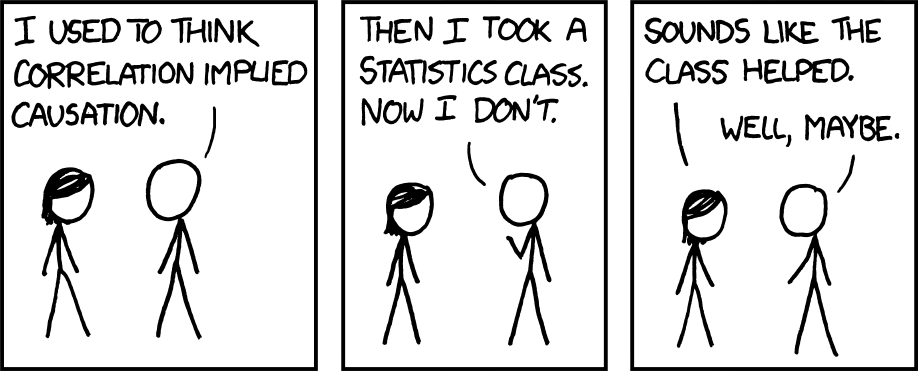
https://xkcd.com/552/

Causal inference = “what if” questions

  1. What would be my headache pain level if I took ibuprofen?
  2. How rich would a country be if it were democratic?
  3. How would police violence change if police are unarmed?
  • Core goal of causal inference: accurate description of causal relationships
    • A change in \(X\) produces a change in \(Y\)
      • E.g., wearing a seatbelt reduces the probability of dying in a car crash
    • But \(X\) and \(Y\) can merely move together without a causal link
      • E.g., ice cream sales and drowning deaths both rise in summer
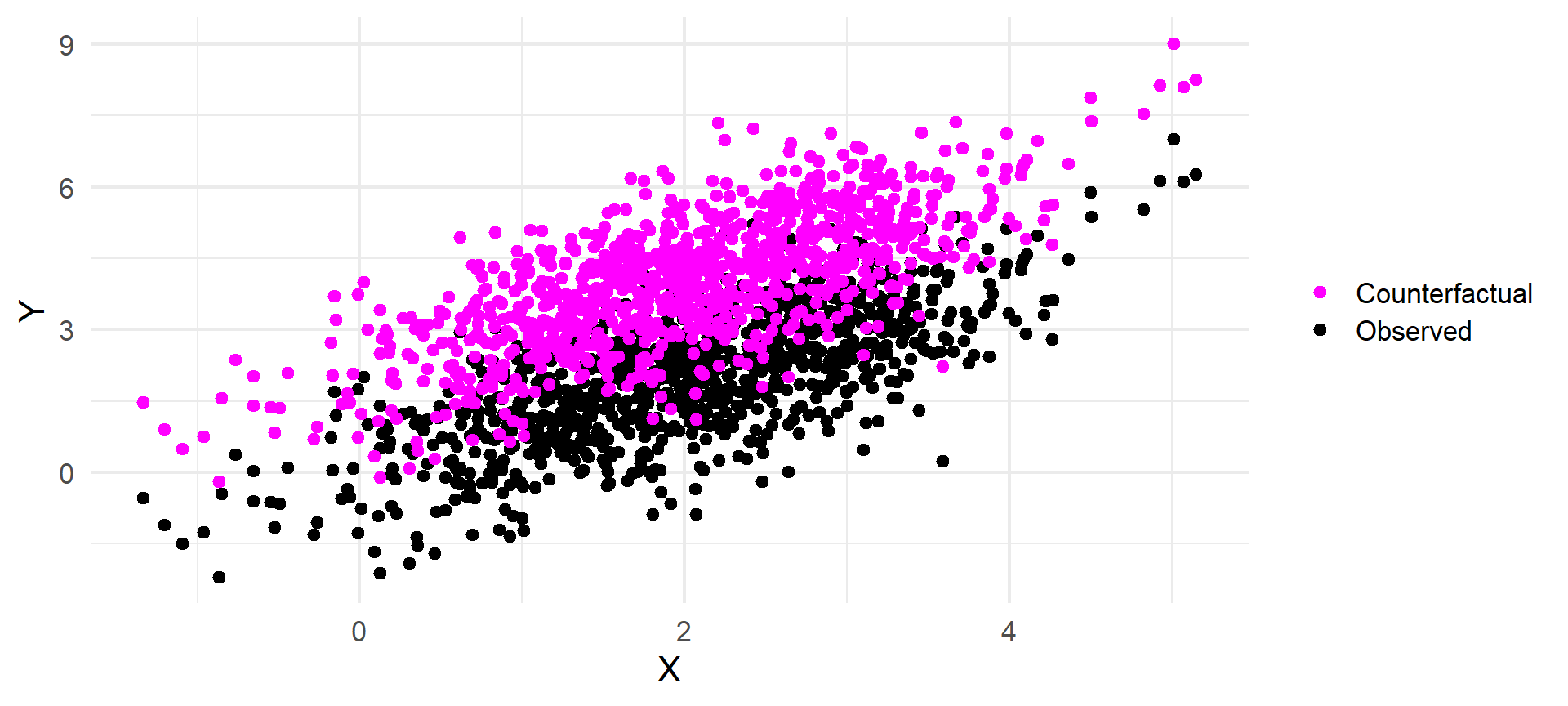
    • We need to compare observed and counterfactual outcomes

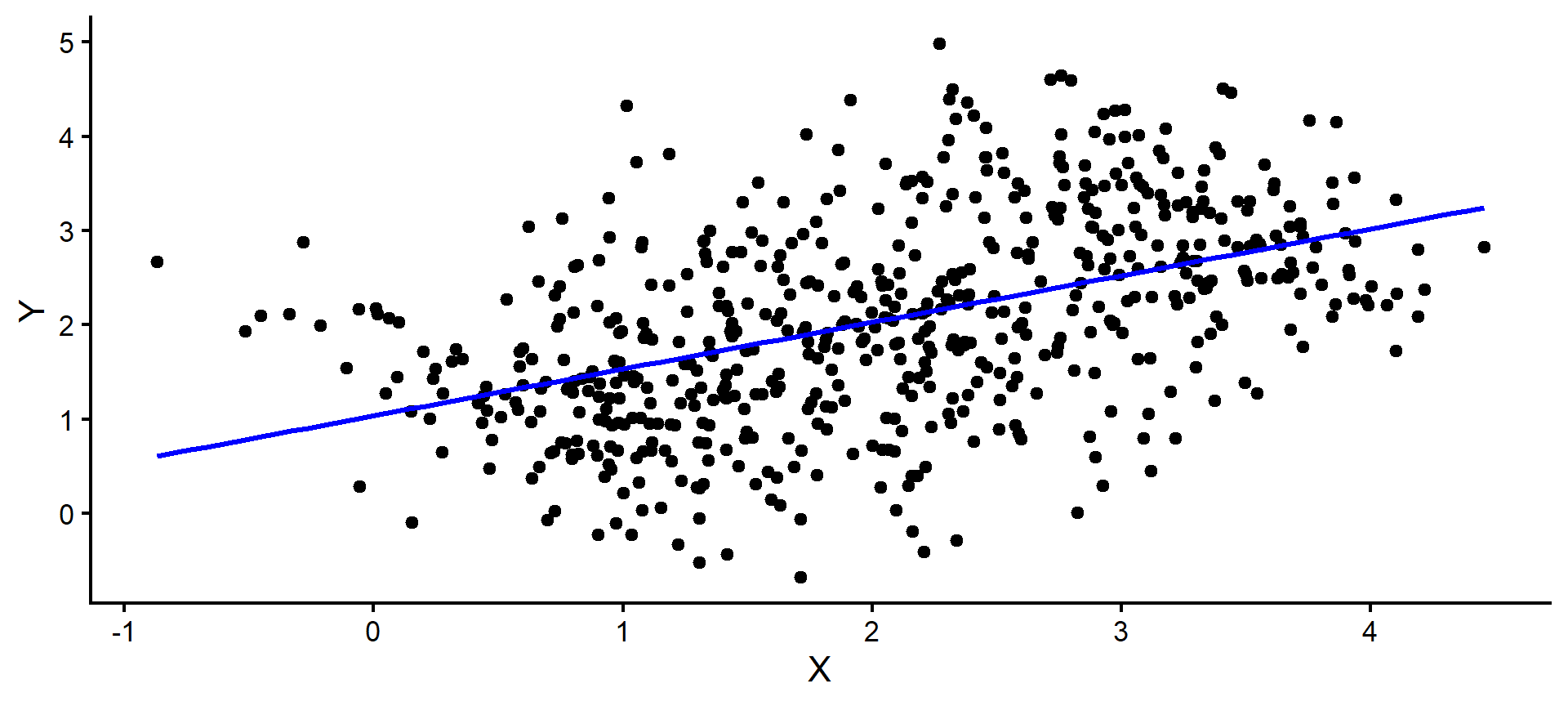
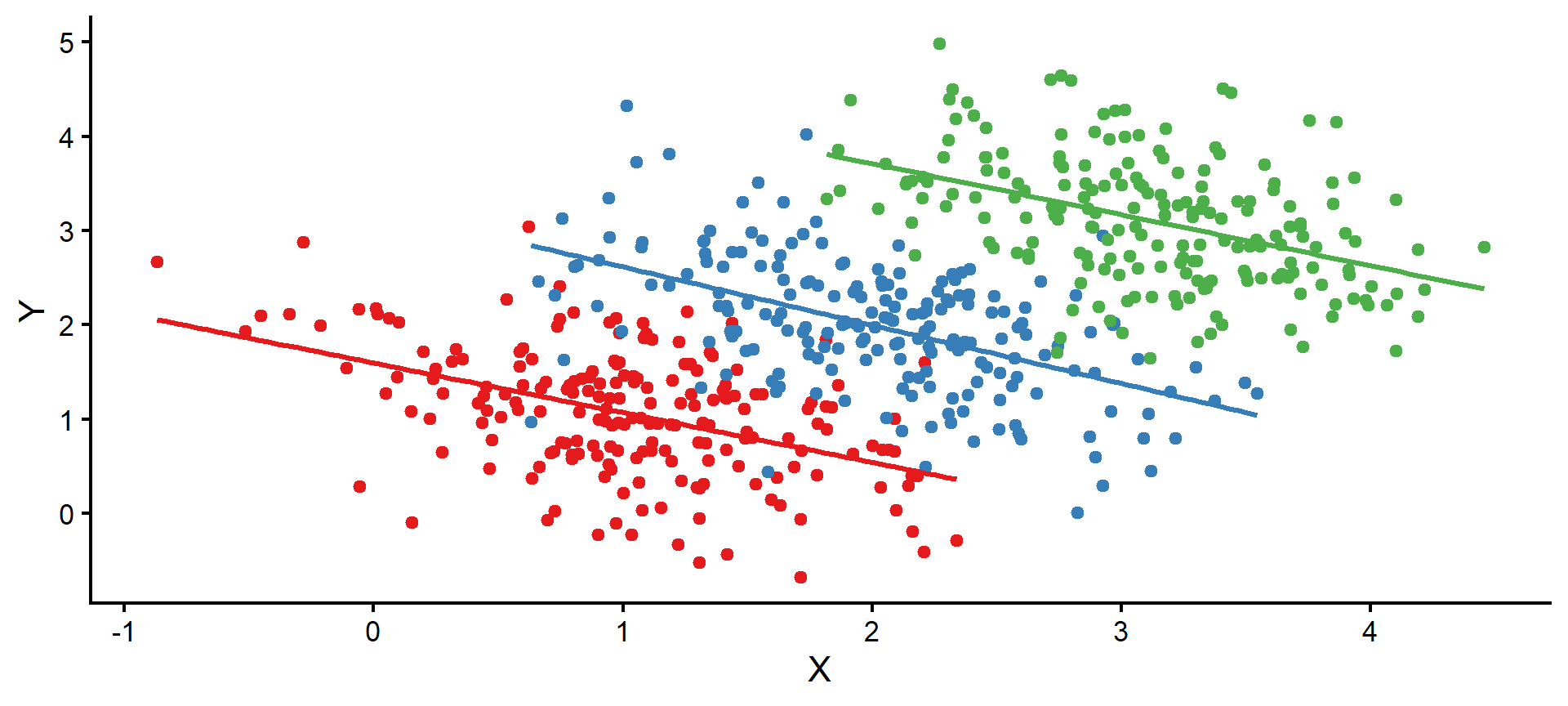
How is correlation different from causation?

How is correlation different from causation?

Example: hospital spending and mortality, where \(X\) is spending per patient, \(Y\) is mortality rate, underlying factor is type of hospital

Counterfactuals represent causality

  • Causation: difference between observed and counterfactual outcomes
  • Causal inference: learn about counterfactuals from observed outcomes

Potential outcomes and causal effects

  • Each unit \(i\) is either treated or not: \(T_i = 1\) if treated, \(T_i = 0\) otherwise
  • Each unit has two potential outcomes:
    • \(Y_i(1)\): outcome if treated
    • \(Y_i(0)\): outcome if not treated
  • The causal effect for unit \(i\) is simply: \(\tau_i = Y_i(1) - Y_i(0)\)
  • But we only ever observe one: \[Y_i = \begin{cases} Y_i(1) & \text{if } T_i = 1 \\ Y_i(0) & \text{if } T_i = 0 \end{cases}\]
  • Fundamental problem of causal inference: \(\tau_i\) is never directly observed

How do we recover causal effects?

  • We can’t observe counterfactual outcomes: we need to estimate them
    • \(Y_i(0)\) for treated units and \(Y_i(1)\) for control units
  • The gold standard: a randomized experiment
    • Random assignment ensures treated and control units are comparable
    • Control group average is a valid counterfactual for the treatment group
      • … in the absence of the treatment
  • But we often can’t randomize: ethically, practically, or politically
  • Instead we look for natural experiments
    • Today: a threshold that determines whether police are armed

Why randomization is the gold standard

  • Randomization produces balanced groups on average
    • Across all observed and unobserved dimensions
  • Any outcome differences between groups must be due to the treatment

Brazil’s Estatuto do Desarmamento (2003)

  • Brazil has some of the highest rates of police killings in the world
  • Guardas municipais: local police forces under municipal governments
    • Distinct from state military police more visible in smaller cities
  • 2003 Statute created population-based rules for arming them:
    • Municipalities ≥50,000 inhabitants: guards permitted to carry firearms
    • Municipalities <50,000 inhabitants: guards restricted from carrying
    • (Metro areas and capitals were exempt; rules applied on duty only)
  • In 2018, Brazil’s Supreme Court suspended the population threshold
    • All guards could now be armed regardless of city size

Regression discontinuity design

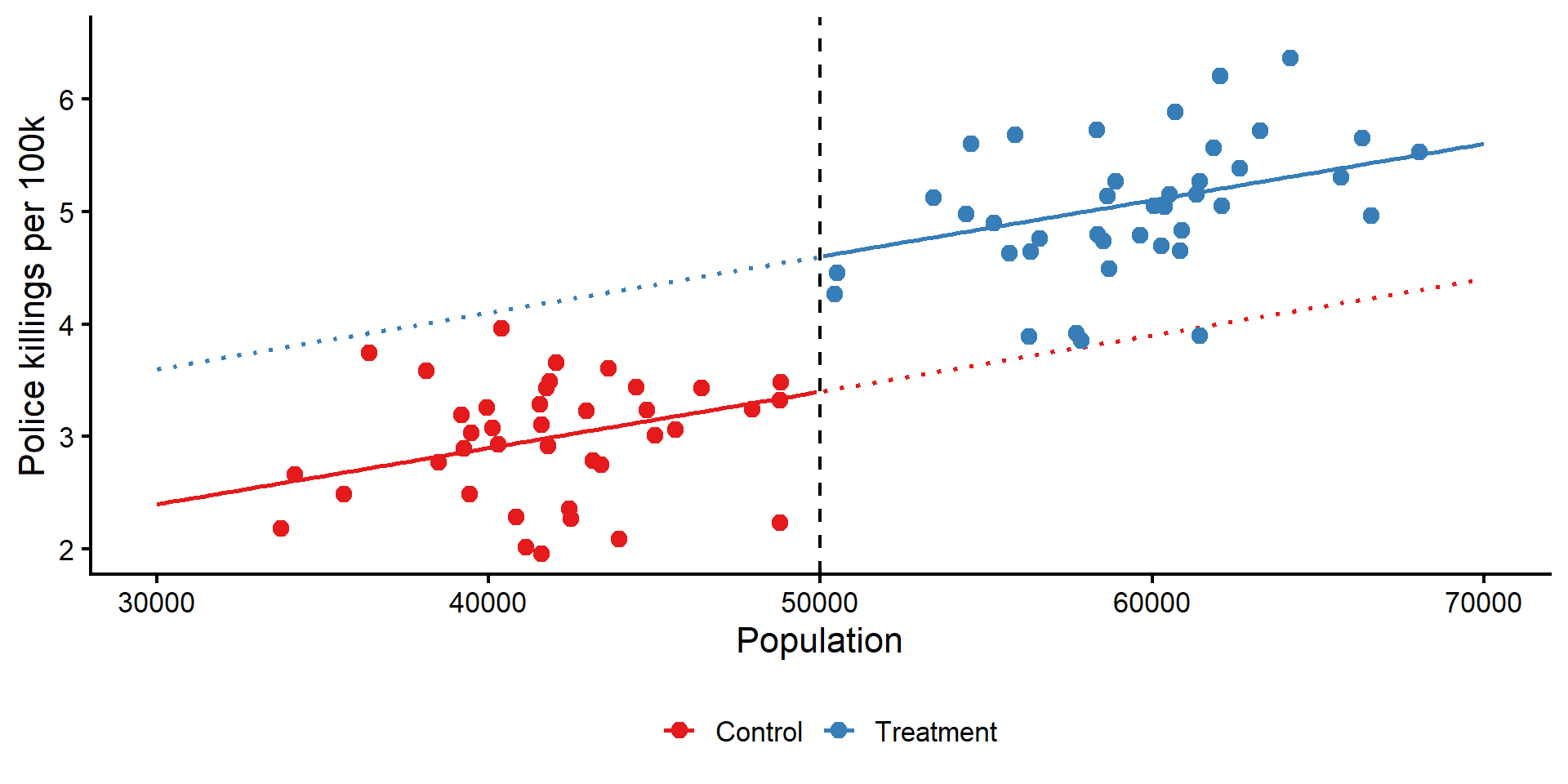
  • A natural experiment where treatment is assigned by crossing a threshold
    • Units just below: control; units just above: treated
  • Key assumption: potential outcomes vary smoothly through the cutoff
    • Any jump in outcomes at the threshold = causal effect of treatment
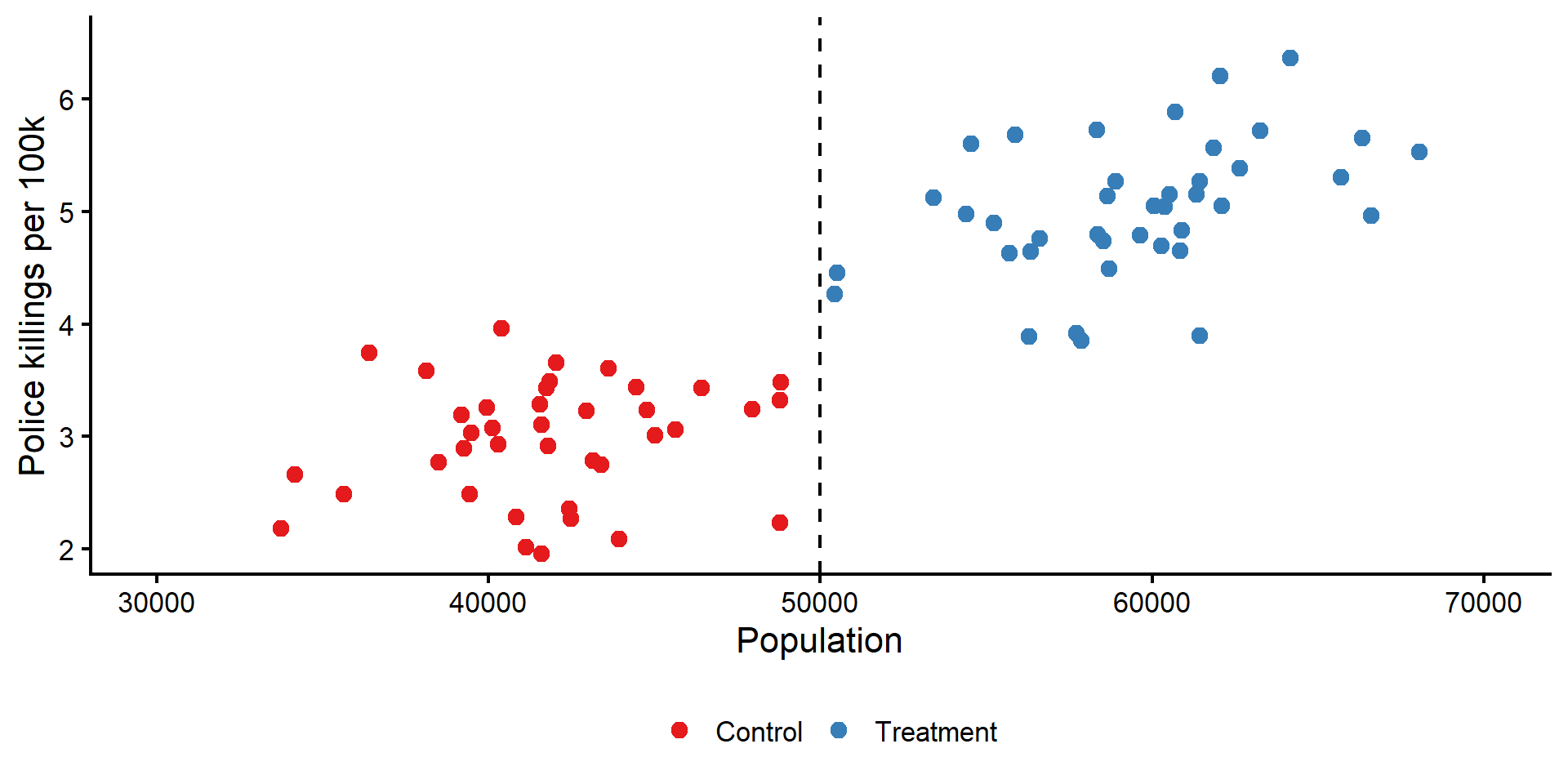
  • Our setting:
    • Running variable \(X_i\): municipality population
    • Cutoff \(c\): 50,000 inhabitants
    • Treatment: municipal guards permitted to carry firearms
    • Outcome \(Y_i\): police killings per 100,000 inhabitants

Regression discontinuity design illustration

Regression discontinuity design illustration

Results

  • Main result: no evidence arming authorization increased killings
  • Validity checks: no discontinuities in other characteristics at the threshold
    • Municipalities just above and below are comparable
  • Temporal dimension: not just above vs. below
    • But whether the gap changes when the law is binding vs. not
  • Why? Survey data shows the law didn’t consistently translate into arming
    • Changing the rules doesn’t change behavior?
  • Help me think through ideas!

Questions?